
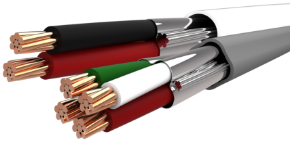
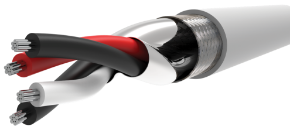

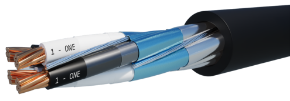
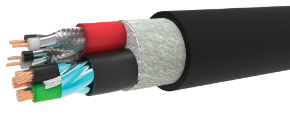
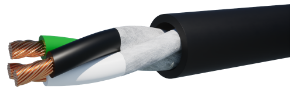
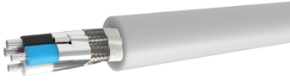
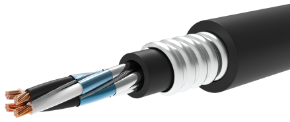

Working with our long-time partner Wesco, Lake Cable recently explored this topic in an article, “Data Center Power Cable: Why DLO Isn’t Necessary.” Published on Wesco's Knowledge Hub platform, the article delivers the welcome explanation for RHW-2’s qualifications as a likely replacement for many data center applications that currently, and expensively, default to DLO. There’s another cable in town that can do many data center jobs as Lake Cable explains…
Why RHW-2 Cable Can Replace DLO Cable in Data Centers
Data centers require reliable cabling, but diesel locomotive cable (DLO) may be overconstructed and costly for many applications. Designed for harsh industrial environments, DLO offers exceptional flexibility and is typically rated for 2,000 volts. However, many protected data center distribution circuits operate at 600 volts or less. For data center power cable, DLO’s specialized construction can add unnecessary cost, weight and installation complexity. Customized rubber-insulated, heat and water resistant (RHW-2) cable offers a practical, cost-effective alternative engineered to meet actual system requirements.
Why DLO Is Over-Engineered for Many Data Center Applications
Rugged DLO is designed for locomotives, mobile equipment, drilling rigs, mining operations and other demanding environments. Its finely stranded copper conductor provides exceptional flexibility, while its ethylene propylene rubber (EPR) insulation helps withstand abrasion, sunlight, oil and harsh operating conditions. These characteristics make DLO well suited for applications involving frequent movement, mechanical abuse or environmental exposure.
Most data center power cable, however, is installed in protected raceways within controlled environments. These installations typically do not require DLO’s continuous flex or heavy-duty construction. DLO may also carry a 2,000-volt rating that exceeds the requirements of distribution circuits operating at 600 volts.
RHW-2: A Practical Alternative for Data Centers
Designed for permanent power distribution, properly specified RHW-2 cable offers several advantages for data center installations. It is available with sunlight-resistant and direct-burial ratings and voltage ratings suited to common distribution systems. Rated for operation at 90°C in wet and dry locations, the cable is suitable for raceways where moisture or condensation may be present. RHW-2 is offered in standard AWG and kcmil conductor sizes and in multiple insulation colors for circuit identification. In addition, RHW-2 is often available with shorter lead times and lower minimum runs. For applications that do not require continuous flexing or exceptional resistance to mechanical abuse, RHW-2 can deliver the necessary performance without the additional cost and complexity of DLO.
Why Pay for Performance You Don’t Need?
DLO’s fine-stranded conductor and heavy-duty construction increase material and manufacturing costs. Customized RHW-2 may provide a more economical solution while offering greater availability and shorter lead times.
Depending on conductor size, construction and order volume, replacing DLO with RHW-2 may reduce cable costs substantially. RHW-2 can also simplify installation by eliminating unnecessary weight and specialized termination requirements.
Potential Data Center Applications
Subject to engineering review and applicable code requirements, RHW-2 may be considered for backup power and uninterruptible power supply interconnections, power distribution unit feeder runs, main service entrance feeders in protected electrical spaces, and permanent power distribution between switchgear and other equipment. RHW-2 may also serve as an alternative in commercial buildings, HVAC systems, manufacturing facilities, renewable energy projects and utility installations.
Before Making the Switch
Contractors may be able to replace DLO with customized RHW-2 cable, such as Lake Cable’s LakeFLEX Pro, without sacrificing performance or reliability. However, RHW-2 should not be treated as an automatic substitute.
Any cable change requires engineer or contractor approval. Before changing cable constructions, contractors and engineers should evaluate voltage, ampacity, conductor size and stranding, short-circuit requirements, adjustment and correction factors, pulling tension, bend radius, termination compatibility, environmental conditions, and applicable codes. When properly specified, RHW-2 can provide a more practical, cost-effective solution tailored to the actual demands of the data center.
View Lake Cable's data center cable offerings, including LakeFLEX Pro, here: https://www.lakecable.com/cable-solutions-for-data-centers